Under the Rug: A Practical Guide to Winning (or Losing) the Floor Lottery
There's a moment in every old-house renovation when someone kneels down in a corner with a Stanley knife and a hopeful expression. The carpet peels back, dust flies up, and everyone leans in to see what the last fifty years have been sitting on. Sometimes it's a beautiful run of original pine. Sometimes it's a 1960s thermoplastic tile stuck down with something black and worrying. Either way, you've just played the floor lottery — and it cost you nothing but a bit of curiosity and a hoover.
Lifting a carpet is one of the last genuinely free discoveries left in a project. You don't need a surveyor, a skip or a spreadsheet. You need a torch, half an hour, and enough self-control not to yank the whole lot up on the day you get the keys.
Why a five-minute corner lift beats a month of guessing
Builders price floors based on what they can see. If all they can see is carpet, you'll get an estimate that hedges — a bit of contingency for "making good", a line about "floor preparation", a shrug. Knowing what's underneath before you ask for quotes turns a vague allowance into a real number, and it stops you agreeing to overboard something that was worth saving.
It also protects you from the classic renovation trap: discovering a floor is knackered halfway through a job, when the budget is already stretched and the only sensible option is the most expensive one.
How to run a proper recce, room by room
You don't need to lift every carpet in the house — a few strategic corners will tell you most of the story.
Start at the door threshold. Gripper rods and door bars are the easiest thing to peel back and replace. Lift a flap of carpet in the doorway and shine a torch underneath.
Then check a corner by the skirting. Old boards often run wall to wall here, and you'll see whether they run lengthways (typical) or have been cut and patched around pipework.
Try the middle of the room with your heel. A dull thud and a bit of bounce suggests boards over shallow joists, or hardboard laid over something uneven. A hard, dead sound is usually concrete or screed.
Look at the fireplace, the radiator and any floor vents. These are where boards get chopped about for pipes and where you can read the age of a floor at a glance.
Take photos and measure. Note the board width, the direction of the run, and any big gaps. Nine-inch boards in a Victorian terrace, four-inch pine in a 1930s semi, tongue-and-groove in a 1980s build — the width alone tells you a lot.
Do this room by room and keep a note on your phone. Hall, front room, back room, kitchen, box room. It'll take an afternoon and it will shape every flooring decision you make afterwards.
What you might find, and what it actually means
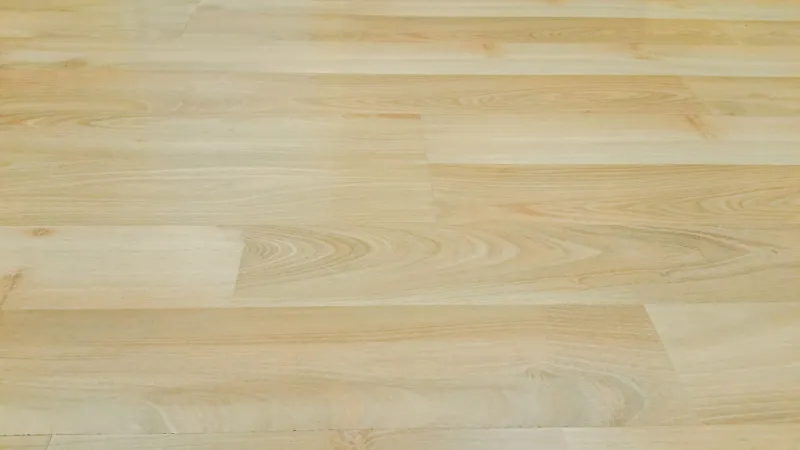
Original pine or softwood boards. The good outcome. They'll be dusty, gappy and possibly painted, but sanding and sealing brings up a floor with far more character than anything you could lay on top. Watch for water staining near radiators and woodworm near joist ends — both are fixable, but they need looking at.
Encaustic or geometric hallway tiles. The lottery jackpot, especially in Victorian and Edwardian terraces. The catch: they're often cracked, missing a few, or covered in decades of adhesive. Reproduction tiles exist and match well, but blending new into old takes patience and a specialist.
Quarry tiles in a kitchen or scullery. Underrated and near-indestructible. Usually fine after a deep clean and a reseal, and worth keeping if the layout allows it.
Hardboard or 6mm ply over the top. Someone has been here before you. Often this hides damaged boards or a draughty floor. Lift a corner and see what's underneath before you assume the worst.
Thermoplastic tiles, black adhesive, or a thin vinyl layer. This is where you slow down. In homes built or refurbished before 2000, these can contain asbestos. Don't sand, don't scrape, don't attack them with a chisel. Leave them intact and get a sample tested — usually £150–£300 through a local UKAS-accredited lab.
A patchwork. Concrete in one corner, boards in another, a slab of self-levelling compound where a wall used to be. Very common after fifty years of alterations. Not a disaster, but it does mean one floor covering over the lot rather than a restoration job.
The honest numbers: restore, overboard or cover
Prices vary wildly by region, but here's roughly where things sit in 2026.
Restoring boards yourself: £70–£110 a day to hire a drum sander and edger, plus £150–£300 in abrasives, filler and finish for an average room. Add a weekend of your life and a lot of dust.
Getting a professional in: £20–£35 per square metre for sanding, gap filling and sealing. A typical 15–20m² sitting room lands somewhere between £350 and £700.
Overboarding with 6mm ply, then carpet or LVT: £15–£25 per square metre for the boarding alone, before the finish. Quick, clean, and a sensible answer when the boards are too far gone.
Tiling: £45–£90 per square metre in labour, plus tiles. Worth it in hallways and kitchens where you want something hard-wearing.
Specialist encaustic restoration: £300–£800 for cleaning and consolidation, more if tiles need lifting and replacing. Get two quotes and ask to see previous work.
The red flags that mean stop and call someone
Gaps you can see daylight through are normal and fixable with draught strips. A floor that visibly bounces when you walk across the middle is not — that's a joist problem.
Stop if you find black mastic, nine- or twelve-inch vinyl tiles, or a fibrous board under the carpet. Stop if there's a damp smell, crumbling screed, or staining around a chimney breast. Stop if the boards flex underfoot near a wall, which can mean rot at the joist ends.
None of these are reasons to panic. They're reasons to get an expert in before you commit to a plan — and before a builder prices a job based on a guess.
What to do with what you've learned
Write it down, photograph it, and take it to your quotes. "Hall: original encaustic, roughly 60% intact, needs a specialist" is a far better brief than "we'd like the floors doing". It keeps your budget honest and it means the floor you end up with is one you actually chose, not one that happened to you.
And if you lift a corner and find something genuinely lovely? Take a photo, put the carpet back down, and enjoy knowing it's there. You've got plenty of time to decide what to do with it — the floor isn't going anywhere.